
Contact Us
Related Posts




Categories



No, Google does not reject or penalize content just because it was created using AI. Google has confirmed multiple times that it evaluates content based on quality and helpfulness, not on the tool used to produce it. What gets penalized is low-effort, unhelpful, or manipulative content, whether that content was written by a human or generated by AI.
This confusion has been going around for years, and it’s understandable why. Google talks about “spam” and “automation” in the same breath as AI, and people assume that means AI content is automatically at risk. It isn’t. Let’s break down exactly what Google has said, what actually gets flagged, and how to use AI content safely without hurting your rankings.
What Google Actually Says About AI Content
Google’s official Search Central guidance on generative content is direct on this point: automatically generating content isn’t against the rules on its own. What matters is accuracy, quality, and relevance, whether that’s the main body text or metadata like titles and meta descriptions.
Google’s spam policy adds one important condition though. Using automation, including AI, with the primary goal of manipulating search rankings is a violation. But the same policy also clarifies that not all automation is spam. Sports scores, weather updates, and transcripts have used automation for years without any issue, because they serve a real purpose for the reader.
So the line Google draws isn’t “AI vs human.” It’s “helpful vs manipulative.”
Why This Myth Won’t Go Away
Three things keep this confusion alive:
- People mix up detection with penalization. Google’s systems can identify patterns typical of AI generation, but detecting that content was AI-assisted is not the same as punishing it for that reason.
- Bad AI content is everywhere. A lot of AI-generated content is genuinely thin, repetitive, or inaccurate, and it does get filtered out. But it’s the quality that’s the problem, not the method.
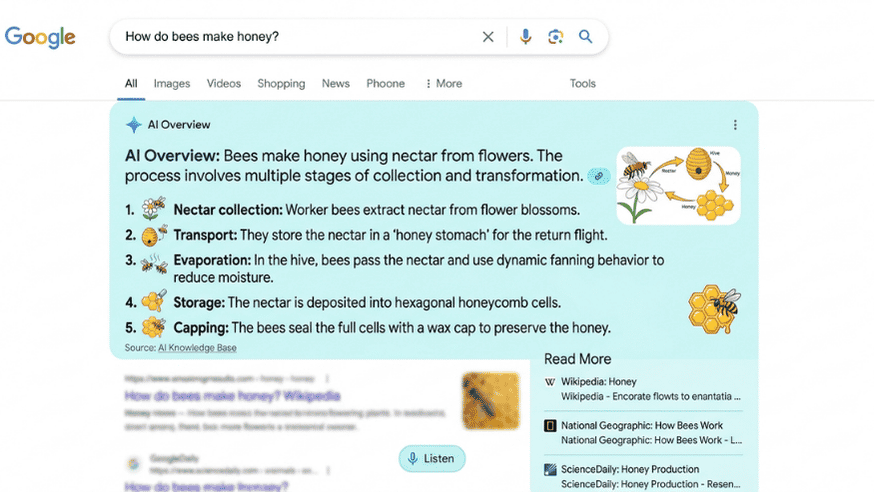
- Google’s own AI Overviews and AI Mode are AI-generated. It would be strange for Google to run one of the world’s most advanced AI systems in Search while blanket-banning AI content from ranking.
What Actually Gets Content Penalized
If it’s not AI itself, here’s what really triggers ranking drops or manual actions:
- Scaled content abuse: publishing large volumes of pages with little to no original value, purely to capture search traffic
- Thin or unedited AI output: content that reads like a raw prompt response, with no fact-checking, no unique insight, and no human review
- Doorway-style pages: near-duplicate pages built around slight keyword variations with no real difference in substance
- Missing E-E-A-T signals: no clear authorship, no demonstrated expertise, no trust indicators like sources or credentials
- Content built only to rank, not to help: pages written around keywords rather than around what the reader actually needs
Any of these can happen with content written entirely by a human too. Google’s Helpful Content system doesn’t check for an “AI” tag before deciding whether a page deserves to rank.
So Is AI Content Safe to Publish?
Yes, as long as it goes through the same bar you’d hold human-written content to. That generally means:
- A human edits, fact-checks, and adds context or experience the AI couldn’t generate on its own
- The content answers the actual search intent, not just the keyword
- Claims are accurate and current, not outdated training data presented as fact
- There’s clear authorship and, where relevant, demonstrated expertise on the topic
- The page adds something the top-ranking pages don’t already say
This is the same standard that separates content which ranks in AI Overviews and People Also Ask from content that quietly disappears from search. Google’s recent guidance on ranking well in AI experiences emphasizes original, first-hand information over generic content that any AI could produce from a prompt. That’s the real bar in 2026: not “is this AI,” but “does this add something the internet doesn’t already have.”
The Bigger Shift: Why This Matters More Now
With AI Overviews and AI Mode answering more queries directly on the results page, getting cited by Google’s AI systems has become just as important as ranking in the traditional blue links. This is where most businesses fall short, not because their content is AI-written, but because it says the same generic thing every competitor’s content already says.
This is exactly what Answer Engine Optimization is built to solve. It’s a structured approach to making your content the kind of source AI systems actually pull from and cite, by focusing on clear direct answers, structured data, original expertise, and content built around real user questions rather than just keywords. If you want your content showing up in AI Overviews and People Also Ask boxes consistently, this is the strategy layer that AI-content-vs-quality debates usually miss.
FAQs
Does Google have a policy against AI-generated content?
No. Google’s official guidance states that automatically generating content is not against its policies on its own. It becomes a problem only when automation is used to manipulate rankings, not because it involves AI.
Can Google detect AI-written content?
Google’s systems can identify patterns common in AI-generated text, but detection is used for quality assessment, not automatic penalization. High-quality AI content is treated the same as high-quality human content.
Will using AI to write blog posts hurt my SEO?
Not by itself. What hurts SEO is publishing AI content without editing, fact-checking, or adding real value. Unedited, generic AI output tends to underperform simply because it lacks the depth and originality Google’s ranking systems reward.
What’s the safest way to use AI for content creation?
Use AI to draft, outline, or research, then have a human editor fact-check, add original insight or experience, and structure the content around what the reader actually needs. This is the same standard Google applies to any content, AI-assisted or not.
Does AI content show up in Google’s AI Overviews? Yes, if it meets the same quality and relevance bar as any other content. AI Overviews pull from pages that demonstrate clear, original, well-structured answers to user queries, regardless of how the page was written.
Want your content structured to actually get cited in AI Overviews and People Also Ask, not just rank on page one? OMR Digital’s Answer Engine Optimization services are built exactly for this.