Contact Us

Services

Related Posts
Categories

Google Demand Gen

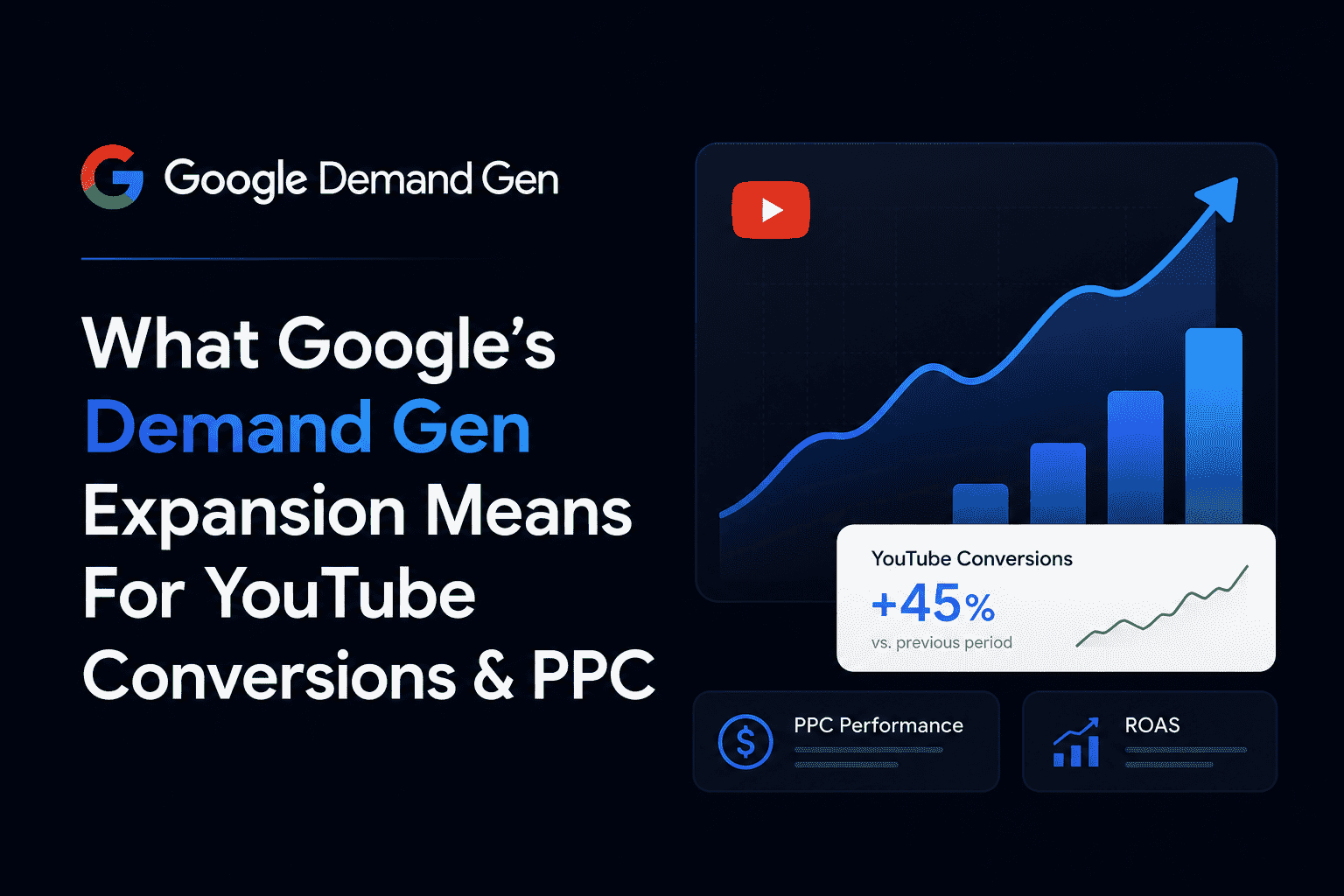
In 2026, digital advertising is no longer limited to search-based intent. It is becoming more visual, predictive, and AI-driven. One of the biggest changes shaping this evolution is Google’s Demand Gen Expansion, which is redefining how brands approach YouTube advertising, display campaigns, and PPC performance.

Google Demand Gen Expansion is not just an upgrade to existing campaign types – it represents a fundamental shift in how Google connects brands with users across YouTube, Discover, and Gmail. Instead of relying only on search intent, it focuses on audience behavior, interests, and visual engagement.

For advertisers, this means better reach, stronger engagement, and more conversion opportunities – but also a need to rethink traditional PPC strategies completely.

Understanding Google’s Demand Gen Expansion 

At its core, Google’s Demand Gen Expansion is designed to help brands generate demand rather than just capture it. Traditional search ads target users who are already looking for something. Demand Gen, on the other hand, focuses on users who are likely to become interested based on their online behavior.

This shift is important because user journeys are no longer linear. People discover products on YouTube, research later on Google, and convert days or weeks afterward.

With Google Demand Gen Expansion, Google uses AI to place visually engaging ads in front of users who are most likely to interact, even if they are not actively searching yet.

Why This Expansion Matters in 2026 

The rise of video content and short-form media has completely changed how users consume information. YouTube Shorts, in-stream videos, and Discover feeds are now primary discovery platforms.

Google Demand Gen Expansion is built around this behavior shift. Instead of showing text-heavy ads, it prioritizes:

  • Video-based storytelling
  • Image-rich creatives
  • Interest-based targeting
  • AI-driven audience prediction

This makes it highly effective for brands trying to build awareness and engagement before conversion.

Impact on YouTube Conversions 

YouTube plays a central role in Google’s Demand Gen Expansion, making it one of the most important channels for advertisers in 2026. 

1. Better Audience Targeting 

Demand Gen uses AI to identify users who are more likely to engage with video content and convert later. This improves conversion quality rather than just increasing impressions. 

2. Higher Engagement Rates 

Since ads appear in visually rich environments like YouTube Shorts and in-stream videos, users are more likely to interact with them compared to static ads. 

3. Stronger Brand Recall 

Video storytelling improves emotional connection, which directly influences purchase decisions and long-term brand recall.

Businesses using Performance Marketing Services are already leveraging this shift to improve campaign efficiency and YouTube ROI.

How PPC Strategy is Evolving 

The introduction of Google Demand Gen Expansion is changing the foundation of PPC advertising.

Earlier, PPC campaigns were heavily focused on keywords, bidding strategies, and manual optimization. Now, the focus is shifting toward audience signals, creative performance, and conversion behavior.

Instead of asking “which keyword should I target,” advertisers now need to think:

  • Who is the audience?
  • What content will engage them?
  • At what stage of the funnel are they?

This makes PPC more strategic and less technical in execution.

Brands investing in PPC Services are now combining search, display, and video campaigns into unified performance systems instead of running isolated ad groups.

Role Of Google Ads In Demand Gen Campaigns 

Google Ads has become more integrated and AI-driven with this expansion. Campaign optimization is now largely automated, helping advertisers improve efficiency and performance.

Businesses using Google Ads Management Services can better structure their campaigns to take advantage of AI-based bidding, placement optimization, and audience targeting.

At the same time, Google Ads Outsourcing Services help brands manage complex Demand Gen campaigns without requiring in-house expertise, ensuring better scalability and results.

Comparison With Traditional Advertising Approaches 

The biggest difference introduced by Google’s Demand Gen Expansion is the shift from intent-based targeting to interest-based discovery.

Traditional PPC focuses on capturing demand – users already searching for a product or service. Demand Gen focuses on creating demand by influencing users earlier in their journey.

This means brands can now reach potential customers before they even realize they need a product or service.

It is a more proactive approach to advertising, especially effective in competitive industries where search demand is limited or expensive.

Integration With Social Media Advertising

One interesting development is how closely Demand Gen now resembles social media advertising.

Platforms like Meta already use interest-based targeting and visual-first creatives. Similarly, Meta Ads Services and Social Media Advertising Services focus heavily on engagement, storytelling, and audience behavior.

With Google’s Demand Gen Expansion, Google is now competing in the same space by offering similar capabilities within its ecosystem.

This convergence allows brands to run more unified cross-platform campaigns instead of treating search and social as separate strategies.

Impact On E-commerce Growth 

E-commerce brands are seeing some of the biggest benefits from Google Demand Gen Expansion.

Instead of relying only on search ads or shopping campaigns, businesses can now showcase products visually before users even search for them.

This is especially powerful for brands focusing on Digital Marketing for E-Commerce, where product discovery often happens through inspiration rather than direct intent.

Demand Gen helps build awareness earlier, which increases the chances of conversion when users later search or revisit products.

Role In SaaS And Lead Generation Campaigns 

For B2B and SaaS companies, Demand Gen campaigns are becoming a strong top-of-funnel strategy.

Businesses working on Lead Generation for B2B SaaS Companies can use video and display ads to explain complex solutions in a simple, engaging format.

Instead of relying only on search intent, they can now influence decision-makers earlier in the research phase, which improves overall conversion pipelines.

Creative Strategy Becomes More Important 

One of the biggest changes brought by Google’s Demand Gen Expansion is the importance of creative quality.

Unlike traditional search ads, Demand Gen campaigns rely heavily on:

  • Video storytelling
  • Emotional engagement
  • Visual appeal
  • Clear messaging

If the creative is weak, even the best targeting will not perform well.

This makes creative strategy just as important as bidding strategy in modern PPC campaigns.

Future Of PPC With Demand Gen 

The future of PPC is clearly moving toward automation, audience intelligence, and visual-first advertising.

We can expect Demand Gen campaigns to become even more advanced with:

  • Smarter AI-based targeting
  • Better predictive audience modeling
  • Deeper integration across Google platforms
  • Increased focus on video content

This will make advertising more efficient but also more competitive.

Conclusion 

Google’s Demand Gen Expansion is transforming YouTube advertising, PPC strategies, and digital marketing performance in 2026.

By shifting focus from keywords to audience behavior and visual engagement, it is helping brands reach users earlier in their buying journey and improve overall conversions.

Businesses that adapt to this shift and integrate Demand Gen with their broader marketing strategy will be better positioned to grow in an increasingly competitive digital landscape.

Smarter SEO ApproachMoving From Paid Ads To Organic Growth: A Smarter SEO Approach For 2026
Google Demand Gen

In 2026, digital advertising is no longer limited to search-based intent. It is becoming more visual, predictive, and AI-driven. One of the biggest changes shaping this evolution is Google’s Demand Gen Expansion, which is redefining how brands approach YouTube advertising, display campaigns, and PPC performance.

Google Demand Gen Expansion is not just an upgrade to existing campaign types – it represents a fundamental shift in how Google connects brands with users across YouTube, Discover, and Gmail. Instead of relying only on search intent, it focuses on audience behavior, interests, and visual engagement.

For advertisers, this means better reach, stronger engagement, and more conversion opportunities – but also a need to rethink traditional PPC strategies completely.

Understanding Google’s Demand Gen Expansion 

At its core, Google’s Demand Gen Expansion is designed to help brands generate demand rather than just capture it. Traditional search ads target users who are already looking for something. Demand Gen, on the other hand, focuses on users who are likely to become interested based on their online behavior.

This shift is important because user journeys are no longer linear. People discover products on YouTube, research later on Google, and convert days or weeks afterward.

With Google Demand Gen Expansion, Google uses AI to place visually engaging ads in front of users who are most likely to interact, even if they are not actively searching yet.

Why This Expansion Matters in 2026 

The rise of video content and short-form media has completely changed how users consume information. YouTube Shorts, in-stream videos, and Discover feeds are now primary discovery platforms.

Google Demand Gen Expansion is built around this behavior shift. Instead of showing text-heavy ads, it prioritizes:

  • Video-based storytelling
  • Image-rich creatives
  • Interest-based targeting
  • AI-driven audience prediction

This makes it highly effective for brands trying to build awareness and engagement before conversion.

Impact on YouTube Conversions 

YouTube plays a central role in Google’s Demand Gen Expansion, making it one of the most important channels for advertisers in 2026. 

1. Better Audience Targeting 

Demand Gen uses AI to identify users who are more likely to engage with video content and convert later. This improves conversion quality rather than just increasing impressions. 

2. Higher Engagement Rates 

Since ads appear in visually rich environments like YouTube Shorts and in-stream videos, users are more likely to interact with them compared to static ads. 

3. Stronger Brand Recall 

Video storytelling improves emotional connection, which directly influences purchase decisions and long-term brand recall.

Businesses using Performance Marketing Services are already leveraging this shift to improve campaign efficiency and YouTube ROI.

How PPC Strategy is Evolving 

The introduction of Google Demand Gen Expansion is changing the foundation of PPC advertising.

Earlier, PPC campaigns were heavily focused on keywords, bidding strategies, and manual optimization. Now, the focus is shifting toward audience signals, creative performance, and conversion behavior.

Instead of asking “which keyword should I target,” advertisers now need to think:

  • Who is the audience?
  • What content will engage them?
  • At what stage of the funnel are they?

This makes PPC more strategic and less technical in execution.

Brands investing in PPC Services are now combining search, display, and video campaigns into unified performance systems instead of running isolated ad groups.

Role Of Google Ads In Demand Gen Campaigns 

Google Ads has become more integrated and AI-driven with this expansion. Campaign optimization is now largely automated, helping advertisers improve efficiency and performance.

Businesses using Google Ads Management Services can better structure their campaigns to take advantage of AI-based bidding, placement optimization, and audience targeting.

At the same time, Google Ads Outsourcing Services help brands manage complex Demand Gen campaigns without requiring in-house expertise, ensuring better scalability and results.

Comparison With Traditional Advertising Approaches 

The biggest difference introduced by Google’s Demand Gen Expansion is the shift from intent-based targeting to interest-based discovery.

Traditional PPC focuses on capturing demand – users already searching for a product or service. Demand Gen focuses on creating demand by influencing users earlier in their journey.

This means brands can now reach potential customers before they even realize they need a product or service.

It is a more proactive approach to advertising, especially effective in competitive industries where search demand is limited or expensive.

Integration With Social Media Advertising

One interesting development is how closely Demand Gen now resembles social media advertising.

Platforms like Meta already use interest-based targeting and visual-first creatives. Similarly, Meta Ads Services and Social Media Advertising Services focus heavily on engagement, storytelling, and audience behavior.

With Google’s Demand Gen Expansion, Google is now competing in the same space by offering similar capabilities within its ecosystem.

This convergence allows brands to run more unified cross-platform campaigns instead of treating search and social as separate strategies.

Impact On E-commerce Growth 

E-commerce brands are seeing some of the biggest benefits from Google Demand Gen Expansion.

Instead of relying only on search ads or shopping campaigns, businesses can now showcase products visually before users even search for them.

This is especially powerful for brands focusing on Digital Marketing for E-Commerce, where product discovery often happens through inspiration rather than direct intent.

Demand Gen helps build awareness earlier, which increases the chances of conversion when users later search or revisit products.

Role In SaaS And Lead Generation Campaigns 

For B2B and SaaS companies, Demand Gen campaigns are becoming a strong top-of-funnel strategy.

Businesses working on Lead Generation for B2B SaaS Companies can use video and display ads to explain complex solutions in a simple, engaging format.

Instead of relying only on search intent, they can now influence decision-makers earlier in the research phase, which improves overall conversion pipelines.

Creative Strategy Becomes More Important 

One of the biggest changes brought by Google’s Demand Gen Expansion is the importance of creative quality.

Unlike traditional search ads, Demand Gen campaigns rely heavily on:

  • Video storytelling
  • Emotional engagement
  • Visual appeal
  • Clear messaging

If the creative is weak, even the best targeting will not perform well.

This makes creative strategy just as important as bidding strategy in modern PPC campaigns.

Future Of PPC With Demand Gen 

The future of PPC is clearly moving toward automation, audience intelligence, and visual-first advertising.

We can expect Demand Gen campaigns to become even more advanced with:

  • Smarter AI-based targeting
  • Better predictive audience modeling
  • Deeper integration across Google platforms
  • Increased focus on video content

This will make advertising more efficient but also more competitive.

Conclusion 

Google’s Demand Gen Expansion is transforming YouTube advertising, PPC strategies, and digital marketing performance in 2026.

By shifting focus from keywords to audience behavior and visual engagement, it is helping brands reach users earlier in their buying journey and improve overall conversions.

Businesses that adapt to this shift and integrate Demand Gen with their broader marketing strategy will be better positioned to grow in an increasingly competitive digital landscape.

Contact Us

Services

Related Posts

Category