
Contact Us
Related Posts



Categories
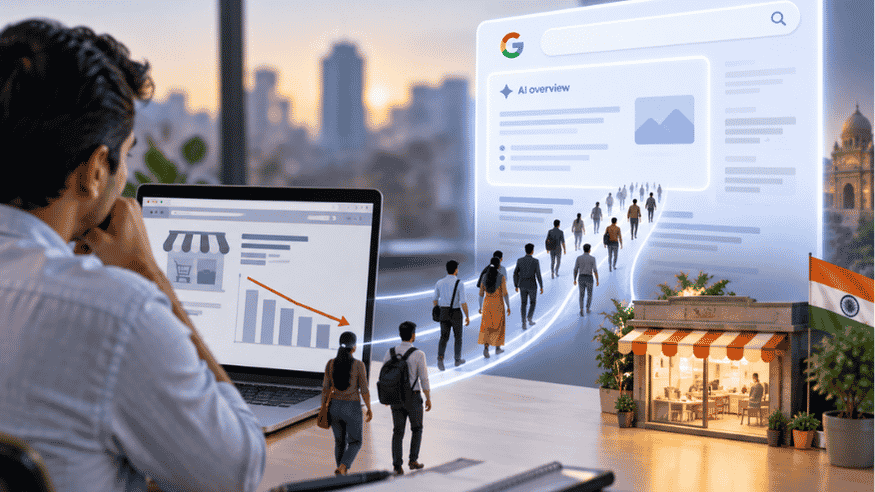
Every major study on AI Overview traffic loss has one thing in common. None of them looked at India.
Pew Research Center tracked 68,879 real Google searches by 900 US adults. Ahrefs analysed 300,000 keywords. Seer Interactive covered 53 brands and 2.43 billion impressions. SparkToro used US panel data. The research is solid, and it all points the same direction — but it describes American search behaviour on American websites.
Indian business owners have been reading those numbers and assuming they apply directly. Some of it does. A significant part of it does not, and the difference matters if you are deciding whether to keep investing in SEO.
What the global research actually found
Start with the established figures, because they frame everything that follows.
Pew Research Center found that users clicked a traditional search result 8% of the time when an AI Overview was present, against 15% when it was absent. That is a 47% relative decline. Only 1% of users clicked a link inside the AI Overview itself.
Ahrefs measured position-one click-through rate dropping 34.5% in April 2025, worsening to roughly 58% by December 2025. Seer Interactive tracked organic CTR on AI Overview queries falling from 1.76% to 0.61%, a 65% collapse, before a partial recovery to 2.4% by February 2026 — still well below the 3.3% baseline on queries where no Overview appears.
One Pew finding gets less attention than it deserves. 26% of users ended their browsing session entirely after seeing an AI Overview, against 16% without one. That traffic did not go to a competitor. It left the web.
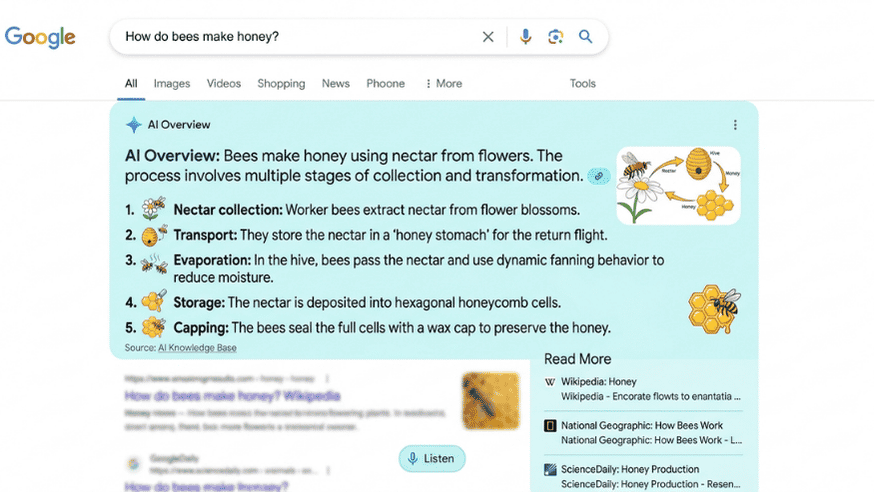
Coverage is expanding as well. AI Overviews now appear on roughly 48% of Google queries, up 58% year on year. If you want the mechanics behind how Google assembles these answers, we covered that in how Google AI Overview works.
Why Indian SMEs are not the same case
Three structural differences mean the global averages overstate the risk for most Indian small and mid-sized businesses.
Your query mix is probably commercial, not informational
This is the single biggest factor, and most coverage skips it entirely.
Ahrefs found that 99.2% of keywords triggering AI Overviews have informational intent. Overviews appear when someone is asking a question, not when they are trying to buy or book.
Now look at what most Indian SMEs actually rank for. “Pest control service in Bangalore.” “Interior designer near me.” “Logistics company Chennai.” “Dental clinic Koramangala.” These are commercial and local queries, and they trigger Overviews far less often than informational ones.
A publisher running an informational blog faces close to the full 48% exposure. A local service business ranking for booking-intent terms may face a fraction of it. Same search engine, very different risk.
India is mobile-first, and the studies mostly are not
AI Overview behaviour differs between desktop and mobile, and most global studies weight desktop more heavily than an Indian traffic profile justifies. SparkToro’s analysis assumed two-thirds mobile and one-third desktop, and excluded searches made inside Google’s mobile app — where the research team noted zero-click behaviour may be even higher.
For a typical Indian SME where mobile is 80% or more of sessions, the transferability of those figures is an open question rather than a settled one.
Regional language coverage is thinner
A meaningful share of Indian search happens in Hindi, Tamil, Kannada, Marathi and other languages. AI Overview coverage in those languages is currently narrower than in English.
Businesses that have invested in regional language content therefore have lower exposure today, though that advantage is temporary and the gap is closing. We covered the ranking side of this in regional SEO for multiple languages in India.
How to measure your own AI Overview traffic loss
A global average is not your number. Here is how to find yours.
Step one: pull your top 50 queries. Open Search Console, go to the Performance report, and export your top 50 queries by impressions over the last six months. Our guide to using Google Search Console for keyword research covers the query-level reporting if you are new to it.
Step two: check which ones trigger an Overview. Search Console does not tell you this, so you have to check manually. Search each query in an incognito window and note whether an AI Overview appears. Fifty queries takes about half an hour.
Step three: split your CTR. Calculate average CTR for the queries that trigger an Overview and, separately, for those that do not. Compare only queries at similar average positions, or position differences will distort the result.
Step four: work out your actual exposure. Multiply the share of your impressions that come from Overview-triggering queries by the CTR gap you measured. That gives you a realistic estimate of clicks lost — and for many SMEs it will be considerably lower than the headline figures suggest.
Query groups in Search Console Insights can help with grouping if you are working across a larger query set.
The three things worth doing about it
Change what you measure
If Overview coverage is rising while CTR on those queries falls, your total clicks can drop even as your visibility improves. Reporting clicks alone will tell you a misleading story.
Track three numbers instead: impressions, CTR split by whether an Overview appears, and conversions from the clicks you still receive. The third matters most. Traffic that was going to bounce anyway is not a loss worth mourning.
Aim to be cited, not just to rank
Seer Interactive found that a page cited inside an AI Overview earns roughly 2.1% CTR, against 0.9% for an uncited page on the same results page. Being cited roughly doubles what you keep.
Ranking well remains the foundation — research from seoClarity found 94% of AI Overviews cite at least one top-20 URL. But the overlap between Overview citations and the organic top 10 has fallen sharply, from around 76% in mid-2025 to between 17% and 54% by early 2026. Pages outside the top ten are being cited more often than before.
Our posts on AEO and visibility in zero-click searches and generative engine optimization cover the mechanics. If you are getting no AI visibility at all, start with why your website is not showing up on ChatGPT.
Strengthen your local signals
For local service businesses, the most effective defence is not content at all. AI systems draw heavily on reviews, citations and Google Business Profile data when answering local queries. Those signals are also the hardest for a competitor to replicate quickly.
We covered the approach in how local service businesses can dominate Google Maps.
The honest answer
How much traffic do Indian SMEs lose to AI Overviews? Nobody has measured it properly yet, and any agency quoting you a precise India figure is extrapolating from American data.
What the evidence supports is this. The global decline is real and well documented, somewhere between 34% and 65% on affected queries depending on method. Your exposure depends almost entirely on how many of your queries trigger an Overview, which for a commercially focused Indian SME is likely well below the 48% global coverage rate. And the direction of travel is one way, so the businesses measuring this now will adapt more comfortably than those waiting for a definitive number.
Spend the half hour on your top 50 queries. Your own data will tell you more than any study.
If you would rather have it done properly, get in touch and we will run the analysis on your Search Console data.
FAQ
How much traffic do AI Overviews actually take?
Global studies put the click-through rate decline between 34% and 65% on queries where an Overview appears, depending on method and position. Your figure depends on how many of your queries trigger an Overview at all, which for most Indian SMEs is lower than the 48% global average.
Do AI Overviews appear on Hindi and regional language searches?
Yes, but coverage is currently thinner than in English. Businesses ranking primarily for regional language queries face less exposure today, though that gap is narrowing.
Is being cited in an AI Overview better than ranking first?
Cited pages earn roughly 2.1% CTR against 0.9% for uncited pages on the same results page, per Seer Interactive. Both sit below the 3.3% baseline when no Overview appears. Citation helps significantly, but it does not replace what was lost.
Should I stop investing in SEO because of AI Overviews?
No. Ranking in the top 20 remains the strongest predictor of AI citation, so the underlying work still matters. What changes is how you measure success and which query types you prioritise.
How do I know if a query triggers an AI Overview?
Search Console does not report it. Check manually in an incognito window, or use a rank tracking tool that flags AI Overview presence at query level.