
Contact Us
Related Posts

























Categories

The Real Growth Problem No One Talks About
You built a solid product. Your team spent months perfecting the onboarding flow. The UI is clean. The features solve a real problem. And yet, signups are trickling in slowly, churn is creeping up, and your CAC keeps climbing every quarter.
This is the most common SaaS growth trap. Companies pour resources into building but underinvest in being found, being understood, and being trusted.
The hard truth? A great product without a strong digital marketing for SaaS engine is like a great restaurant hidden in a basement with no signboard. People who already know you will come. Everyone else will just walk past.
This article breaks down exactly why digital marketing is not optional for SaaS companies anymore, and what a practical approach looks like.
What Makes SaaS Marketing Fundamentally Different
Before jumping into tactics, it helps to understand why SaaS marketing is not the same as marketing a physical product or a one-time service.
It Is All About Monthly Recurring Revenue
In SaaS, the goal is not just to get a customer. It is to keep them, grow them, and reduce churn. Every marketing decision should be looked at through the lens of MRR impact, not just top-of-funnel volume.
A SaaS company that acquires 500 users but loses 200 every month is running on a leaky bucket. Marketing has to work alongside product and customer success to fix that leak.
CAC and LTV Are Your North Star Metrics
Customer Acquisition Cost (CAC) and Lifetime Value (LTV) are the metrics that define whether your marketing is actually working or just burning money.
If your LTV is ₹50,000 (or $600) and your CAC is ₹60,000 (or $720), you are in trouble regardless of how many leads you are generating. SaaS marketing strategy has to be built around improving this ratio, not just generating noise.
Buyers Take Time to Decide
Unlike an e-commerce purchase, B2B SaaS decisions often involve multiple stakeholders, procurement processes, and 3 to 9 month decision cycles. A prospect might read your blog in March, compare you with competitors in June, and finally sign up in September.
This means your marketing has to stay present at every stage of that journey. One-shot campaigns do not work here.
Engagement Does Not Stop at Signup
In SaaS, acquisition is the beginning, not the end. Marketing needs to support activation, reduce time-to-value, and help users build habits around the product. This is where most early-stage SaaS companies drop the ball.
Why Digital Marketing Is Critical for SaaS Growth
1. Scalable Customer Acquisition Without Linear Cost
Paid sales teams scale linearly. You want 2x more customers, you hire 2x more salespeople. Digital marketing does not work that way.
A well-optimized blog post or a solid Google Ads campaign can bring in leads around the clock without proportional cost increases. For SaaS companies targeting growth with lean teams, this efficiency is not a nice-to-have. It is a survival tool.
2. Building Trust Before the First Click
Most SaaS buyers do significant research before they ever fill out a form. They read reviews on G2, look up your competitors, watch YouTube demos, and check if your company actually knows what it is talking about.
B2B SaaS marketing is fundamentally a trust game. If your content, website, and social presence signal expertise and reliability, you win before the sales conversation even starts.
A company like Notion grew largely because their content and community made people feel like they were part of something, not just buying software.
3. Educating Users on Complex Products
SaaS products often solve sophisticated problems. If a potential buyer does not understand how your product solves their problem, they will not buy, no matter how good your demo is.
Content marketing, comparison pages, use-case landing pages, and video walkthroughs all serve one purpose: reducing the cognitive load on your buyer. The easier you make it to understand your value, the faster deals close.
4. Supporting Product-Led Growth
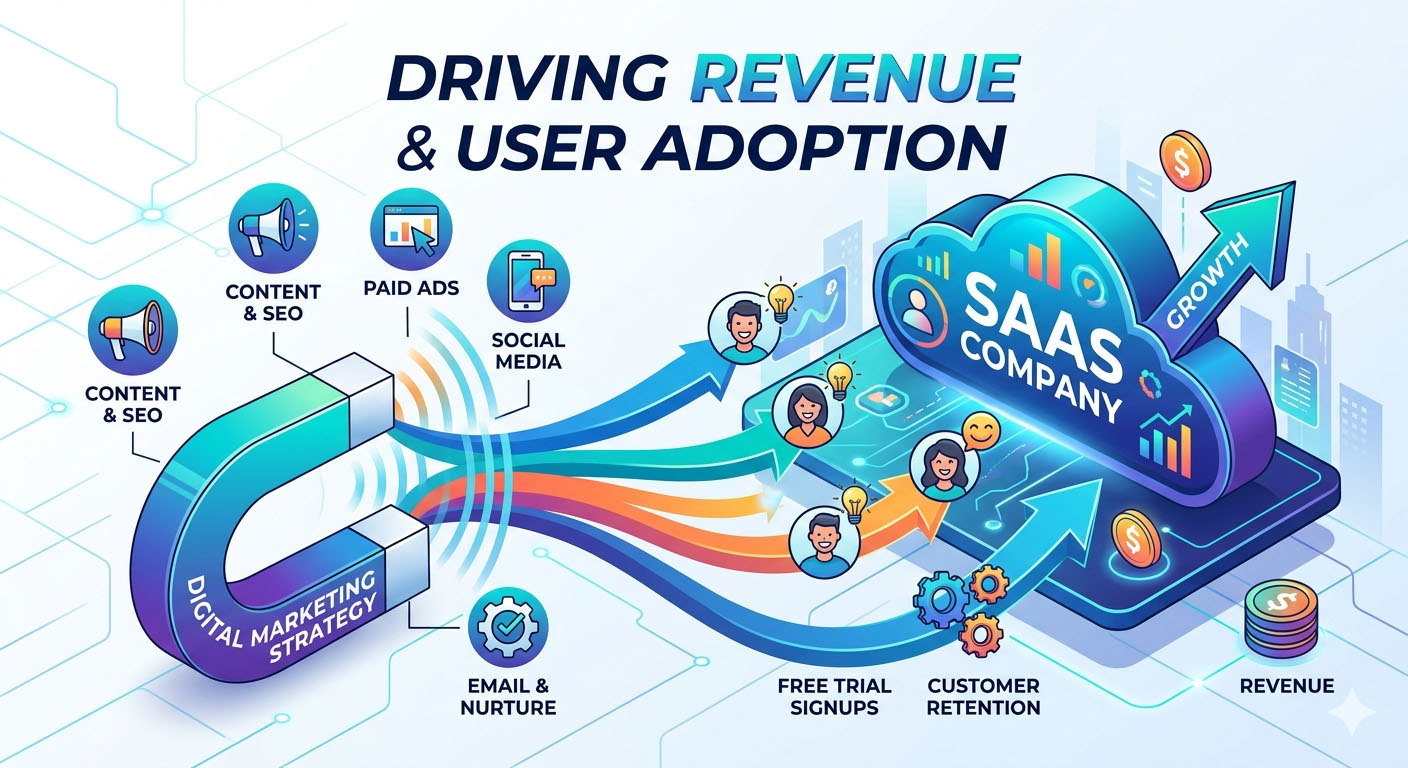
If your SaaS has a freemium or free trial model, digital marketing feeds the top of that funnel. SEO brings in users who are actively searching for solutions. Retargeting brings back those who explored but did not convert. Email sequences guide free users toward paid plans.
Without a deliberate digital marketing layer, even the best PLG motion stalls at low traffic volumes.
5. Data-Driven Optimization at Every Stage
One of the biggest advantages of digital marketing is that almost everything is measurable. You can track where users come from, what content converts, which ad copy resonates, and where people drop off in your funnel.
This feedback loop is what separates fast-growing SaaS companies from those stuck guessing. When you run campaigns with proper UTM tracking and funnel analytics, every decision improves over time.
Best Digital Marketing Channels for SaaS Companies
Not all channels work equally well for every SaaS company. But here are the ones that consistently deliver results.
SEO and Content Marketing: Long-Term Compounding Growth
SEO is the channel that keeps giving. A well-researched article targeting the right keywords can bring in qualified traffic for years with minimal ongoing investment.
For SaaS companies, the most effective content strategy includes:
- Bottom-of-funnel pages: Comparison pages (Your Tool vs Competitor), use-case pages, and pricing pages
- Middle-of-funnel content: Guides, tutorials, and how-to articles that address pain points
- Top-of-funnel content: Industry trends and educational pieces that build brand awareness
HubSpot is the gold standard here. Their content engine drives millions of monthly visitors, most of whom eventually enter their funnel.
Google Ads: High-Intent Lead Generation
Search ads on Google target buyers who are actively looking for a solution. Someone typing “best project management tool for remote teams” is much closer to buying than someone scrolling LinkedIn.
For SaaS customer acquisition, Google Ads works best when paired with high-converting landing pages and a strong retargeting setup. Running ads to a generic homepage is one of the biggest wastes of SaaS marketing budgets.
LinkedIn Marketing: The B2B Sweet Spot
For B2B SaaS targeting decision-makers, LinkedIn is hard to beat. You can target by job title, company size, industry, and even specific companies you want to land.
LinkedIn works well for:
- Promoting thought leadership content
- Running lead gen campaigns for demos or trials
- Building brand recall among your ICP (Ideal Customer Profile)
The CPCs are higher than other channels, but the lead quality in B2B SaaS is usually worth it.
Email Marketing: Nurturing and Retention
Email remains one of the highest ROI channels in SaaS. It is where you nurture leads who are not ready to buy, onboard new users, upsell existing customers, and win back churned accounts.
A basic but effective SaaS email stack includes:
- A welcome sequence for new signups
- A trial-to-paid conversion sequence
- A monthly newsletter for engaged users
- A churn-risk reactivation campaign
If your email strategy is just a monthly product update blast, you are leaving significant revenue on the table.
Retargeting: Converting the Fence-Sitters
Most people who visit your website for the first time will not convert. Retargeting ads on Google, LinkedIn, and Meta let you stay in front of those visitors and bring them back when they are ready.
This is especially powerful for SaaS because of those long decision cycles mentioned earlier. Someone who read your blog in month 1 might need four more touchpoints before they request a demo. Retargeting makes sure those touchpoints happen.
Common Digital Marketing Mistakes SaaS Companies Make
Even companies with smart teams make these errors repeatedly.
Running ads without a proper funnel. Spending on Google or LinkedIn but sending traffic to a weak landing page or generic homepage is one of the fastest ways to burn budget.
Ignoring content entirely. Some SaaS founders believe paid ads are enough. They work until they stop. Content builds an asset. Ads build dependency.
No clear ICP in messaging. When your homepage tries to speak to everyone, it resonates with no one. Nail your ICP first. Everything else gets easier.
Treating onboarding as a product problem. Email onboarding sequences, in-app guidance driven by marketing automation, and educational content are all part of the marketing function. Weak onboarding kills retention, which forces you to spend more on acquisition. A lose-lose loop.
Measuring vanity metrics. Impressions and follower counts do not pay salaries. Track pipeline generated, trial signups, demo requests, and MRR influenced by marketing.
A 90-Day Practical SaaS Marketing Plan
If you are starting from scratch or rebuilding your marketing, here is a realistic 90-day roadmap.
Month 1: Foundation and Setup
- Define or sharpen your ICP (industry, company size, role, pain points)
- Audit your website for messaging clarity and conversion readiness
- Set up GA4, a CRM, and proper UTM tracking
- Identify 20 to 30 high-intent keywords for your SEO roadmap
- Build a basic email onboarding sequence for new signups
Month 2: Launch Core Channels
- Publish your first 4 to 6 SEO-focused blog posts
- Launch a Google Ads campaign targeting bottom-of-funnel keywords
- Start a LinkedIn content cadence (3 posts per week from your brand or founder)
- Set up basic LinkedIn Lead Gen campaigns targeting your ICP
- Create dedicated landing pages for your top 2 to 3 use cases
Month 3: Optimize and Scale
- Set up Google and LinkedIn retargeting audiences
- Launch a trial-to-paid email nurture sequence
- Analyze which content and ads are driving actual signups, not just traffic
- Double down on what is working. Cut or pause what is not.
- Start building 2 to 3 backlinks per month to your core SEO pages
This is not a magic formula. But companies that execute this consistently over 90 days almost always see measurable improvement in pipeline and CAC efficiency.
The Bottom Line
Digital marketing for SaaS is not about chasing the newest platform or running aggressive growth hacks. It is about building a system that consistently attracts the right people, educates them about your product, and moves them toward becoming long-term customers.
The SaaS companies that win are not always the ones with the best product. They are the ones that show up consistently, build trust over time, and treat marketing as a revenue function, not a support function.
Start with the fundamentals. Execute with discipline. Optimize based on data. That is how sustainable SaaS growth actually happens.