
Contact Us
Related Posts

Categories
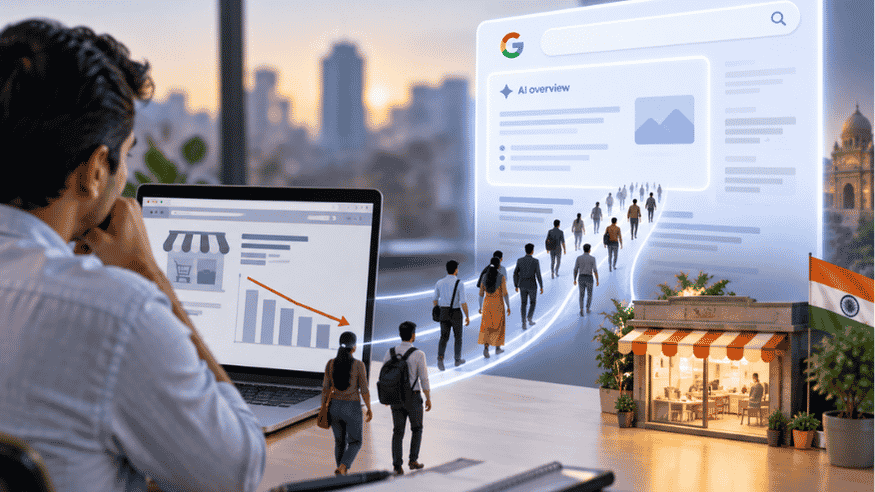 How Much Traffic do Indian SMEs Actually Lose to AI Overviews?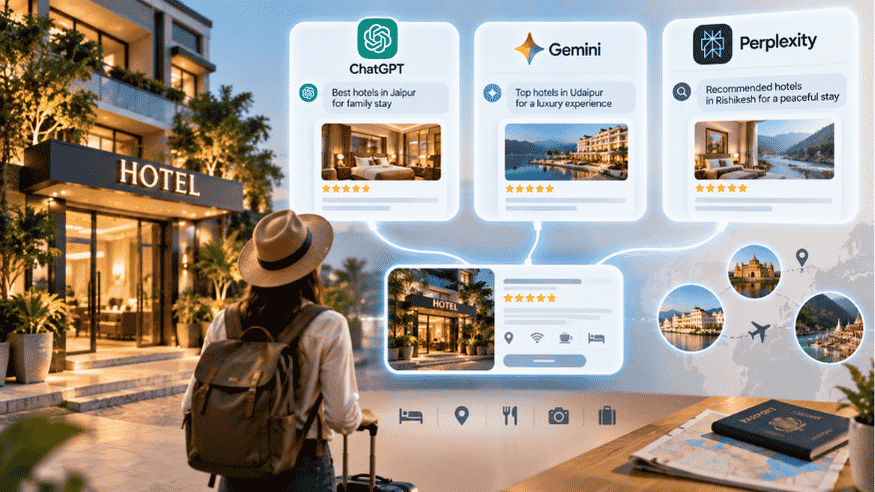
A growing share of travelers no longer start their hotel search on Google. They open ChatGPT, Gemini, or Perplexity and type something like “best boutique hotel near Connaught Place with a rooftop pool” or “family-friendly resort in Goa under ₹8,000 a night.” The AI doesn’t return ten blue links — it returns two or three recommendations, sometimes with a short reason why. If your hotel isn’t one of them, you didn’t lose a click. You lost the booking entirely, and you may never know it happened.
This is the new front door of hospitality discovery, and it runs on different rules than the ones most hotel websites were built for.
Why Hotel SEO Alone No Longer Guarantees You Get Recommended by AI
Ranking on page one of Google used to be the finish line. It isn’t anymore. AI trip planners pull from a wider mix of sources — review platforms, travel blogs, structured data, third-party mentions — and they don’t necessarily favor the same pages Google ranks first. A hotel can have solid organic rankings and still be invisible in ChatGPT’s answer because the AI never found a confident, well-structured reason to recommend it. We’ve covered why this gap exists in detail in why your website might not be showing up on ChatGPT — the short version is that AI engines reward clear, citable answers over keyword-optimized pages.
That doesn’t mean traditional hotel SEO is wasted. It’s still the foundation. Our guide on why search engine optimization for hotels is essential in 2025 covers the technical and content basics every property needs first. AI visibility is the next layer built on top of that foundation, not a replacement for it.
How AI Trip Planners Actually Choose Which Hotels to Recommend
ChatGPT, Gemini, and Perplexity don’t “crawl” your hotel the way Google does. They synthesize an answer from whatever sources they can retrieve and trust at the moment of the query, then decide which two or three options are worth naming. Three things heavily influence that decision:
- Entity clarity — does the AI clearly understand what your hotel is, where it is, what it offers, and who it’s for?
- Corroboration — do multiple independent sources (review sites, travel guides, local directories, press) describe your hotel consistently?
- Answerability — is the specific detail the traveler asked about (rooftop pool, pet-friendly, near the airport, budget-friendly) actually stated somewhere the AI can find and quote confidently?
We explained the mechanics behind this shift in how Google’s AI Overview works and in our broader primer on what generative engine optimization (GEO) is and why it matters. Both apply directly to hospitality: AI engines are mapping entities and answering specific questions, not matching keywords to pages.
The Content and Data Signals That Get Hotels Cited by AI
For a hotel, this translates into a few concrete priorities:
Structured, specific pages beat vague brochure copy. A page that says “luxurious rooms and world-class hospitality” gives an AI nothing to cite. A page that says “42 rooms, rooftop infinity pool, 10-minute drive from the airport, pet-friendly on request” gives it an exact answer to quote. Write hotel and room-type pages as if you’re answering the traveler’s actual question, not selling a mood.
Schema markup matters more here than almost anywhere else. Hotel schema, room schema, review schema, and FAQ schema give AI systems machine-readable facts — star rating, amenities, price range, location — that are far easier to trust and cite than paragraphs of prose. If your site hasn’t implemented this yet, it’s one of the highest-leverage fixes available.
Reviews and third-party mentions are doing more work than your own website. AI engines treat consistent descriptions across TripAdvisor, Google reviews, travel blogs, and booking platforms as corroboration. Our post on how brand mentions and backlinks work in AI-driven search breaks down why a hotel with active, consistent third-party coverage tends to outperform one with a beautiful website and no external footprint — even if the website ranks higher on Google.
Freshness and specificity beat volume. You don’t need fifty blog posts. You need a handful of pages that answer real traveler questions precisely: “Is [Hotel] good for a wedding?”, “Does [Hotel] have airport pickup?”, “What’s the cancellation policy at [Hotel]?” Each of these is a plausible AI prompt, and each deserves a direct, quotable answer somewhere on your site.
Local Pack, Google Business Profile, and Zero-Click Visibility
Hotels live and die by local discovery, and that hasn’t changed with AI — it’s actually become more connected. Google’s AI Overviews and AI Mode draw heavily on the same local signals that feed the traditional Local Pack. Our guide to what Google’s Local Pack is and how to rank in it is directly relevant: a complete, accurate, actively managed Google Business Profile is now doing double duty as an AI visibility asset.
This sits inside a bigger shift we cover in the rise of zero-click searches — more travelers are getting their answer without ever clicking through to a website. For hotels specifically, our hospitality local SEO guide covers the profile, citation, and review hygiene that AI engines and Google’s Local Pack both depend on.
Building an AI Visibility Strategy for Your Hotel or Resort
Putting this together, a practical starting checklist looks like this:
- Audit your entity clarity. Ask ChatGPT, Gemini, and Perplexity a handful of realistic questions about your hotel and your category. Note what they get right, what they get wrong, and which competitors they mention instead.
- Add hotel, room, and FAQ schema to every property and room-type page.
- Rewrite key pages around specific traveler questions rather than generic selling language.
- Strengthen your Google Business Profile with accurate categories, complete amenities, and regularly updated photos and posts.
- Build consistent third-party presence — reviews, local directories, travel guides — so independent sources corroborate what your website says.
- Track citation share, not just rankings. Rankings tell you where you sit on Google. They don’t tell you whether ChatGPT mentioned you last week.
If your property is part of a larger hospitality group with resorts, spas, or banquet properties under one brand, the same principles apply across each — see our dedicated pages on digital marketing for resorts and the hospitality industry for category-specific detail.
How OMR Digital Helps Hotels Win in AI Search
At OMR Digital, our hotel digital marketing services now build AI visibility into the same strategy as SEO, local search, and paid campaigns — because for hospitality brands, these are no longer separate channels competing for budget. They’re the same discovery funnel, split across Google, ChatGPT, Gemini, and Perplexity. We also work with travel agencies and tour operators facing the identical shift, since the traveler asking an AI for a hotel recommendation today is often the same traveler asking it to plan the whole trip tomorrow.
The Takeaway
Getting recommended by an AI trip planner isn’t about gaming a new algorithm — it’s about giving AI systems the same clear, specific, corroborated information a well-trained human concierge would use to make a recommendation. Hotels that build this now, while most competitors are still optimizing for Google alone, have a real window to become the default answer before that window closes.