
Contact Us
Related Posts













































Categories
 Hindi and Vernacular SEO: Is It Worth It for Indian Businesses?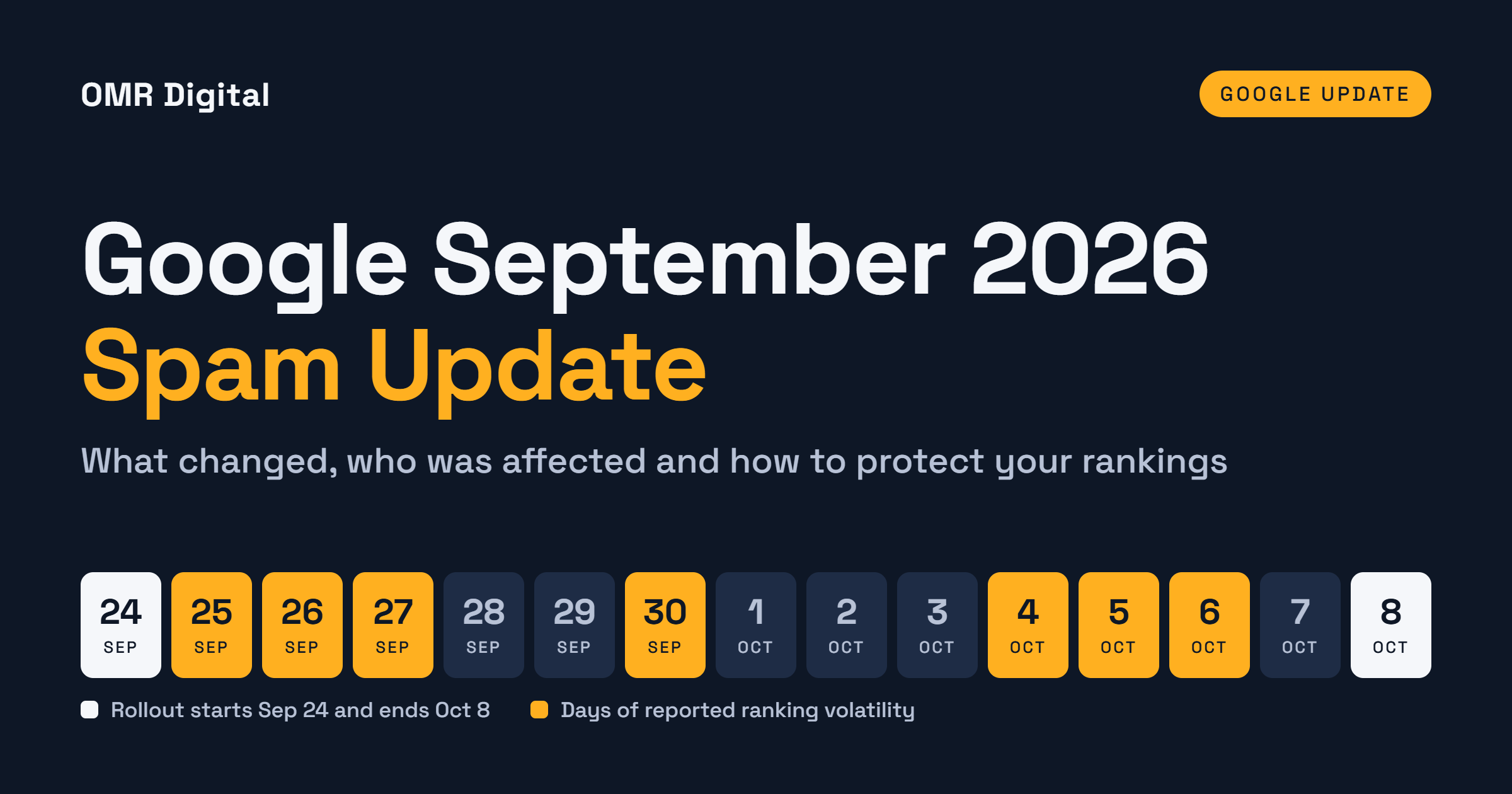
Google’s September 2026 spam update finished rolling out on October 8, 2026. If your organic traffic or rankings moved in the last three weeks, this update is one of the first things to check.
This was not a routine spam update. It ran for almost two weeks, much longer than the spam updates Google released earlier this year. Here is what happened, what it means, and what we recommend you do now.
The September 2026 Spam Update at a Glance
- Started: September 24, 2026
- Completed: October 8, 2026 (about 13 days)
- Scope: Global, across all languages
- Target: Sites that break Google’s search spam policies
- Type: A general spam update, not a dedicated link spam update
Google described it as a normal spam update and said the rollout could take up to two weeks. It did not share what share of searches or sites were affected.
Why This Update Felt Different
This was Google’s fourth spam update of 2026, after March, June and August. Those three each finished in roughly one to three days. This one took nearly two weeks.
That matters for two reasons:
- Rankings moved in waves. Industry trackers reported the heaviest volatility on September 25 to 27, September 30, and October 4 to 6. Your site may have shifted on one of those dates rather than all at once.
- It felt bigger than a spam update. Some SEO professionals said the effect resembled a core update. Google has not called it one, and the volatility dates above come from third-party tracking, not from Google.
What Google Spam Updates Actually Do
Google’s automated systems, including its AI-based system SpamBrain, are always working to detect spam. A “spam update” is Google’s label for a notable improvement to those systems. When it happens, sites that break the spam policies can rank lower or disappear from results altogether.
Two points are easy to miss:
- There is no notification. A spam update is algorithmic. You will not see a message in Google Search Console the way you would with a manual action.
- Recovery is slow. Google has said that improvement can take months, because its systems need time to recognise that a site now follows the rules. Periodic refreshes of the system also happen, so the next check-in point may not be immediate.
Which Practices Put Sites at Risk
The update did not announce new rules, so the existing spam policies are the reference. The practices we see cause the most trouble for businesses include:
- Scaled content abuse: publishing large volumes of pages, often auto-generated or AI-written, mainly to capture search traffic rather than help users
- Doorway pages: many near-identical pages targeting slight variations of a keyword or city
- Cloaking and sneaky redirects: showing Google different content from what visitors see
- Hidden text and keyword stuffing
- Site reputation abuse: hosting low-value third-party content on a trusted domain to borrow its ranking power
- Expired domain abuse: buying old domains to push thin content
- User-generated spam: unmoderated comments, forums or profile pages filling up with junk
- Misleading authorship: Google also warned on October 6 against using fake author information on content
If your site is a local-service, e-commerce or multi-location business, pay special attention to doorway-style location pages and templated product or service pages.
How to Check Whether You Were Hit
A traffic dip does not automatically mean a spam penalty. Seasonality, tracking errors, and other changes can look similar. Work through this checklist:
- Compare the right windows in Search Console. Look at clicks and impressions for the two weeks before September 24 against the period after October 8. Check the volatile dates (Sept 25 to 27, Sept 30, Oct 4 to 6) closely.
- Find where the drop happened. Segment by page type, folder, country and device. A spam hit usually concentrates on specific sections, not the whole site.
- Check for manual actions. If Search Console shows a manual action, that is a separate issue with a separate recovery process.
- Rule out technical causes. Confirm there were no migrations, robots.txt or noindex changes, broken analytics tags, or server problems in the same period.
- Audit the affected pages against Google’s spam policies. Be honest about thin, repetitive, auto-generated or manipulative pages.
Also remember that Google had other changes in motion this year, so avoid blaming a single cause before you have looked at the data.
What to Do if Your Rankings Dropped
Google’s guidance has not changed: review the spam policies and make sure your site complies. In practice, that means:
- Remove or rewrite low-value pages. Consolidate near-duplicate pages, and delete or noindex content that exists only to catch search traffic.
- Fix manipulative tactics. Clean up hidden text, keyword stuffing, deceptive redirects and cloaking.
- Audit AI-assisted content. AI use is not the problem by itself. Publishing it at scale without real expertise, editing or originality is.
- Review third-party and user-generated content. Moderate comments and profiles, and tag outbound links appropriately.
- Strengthen real signals of trust. Show genuine authors, credentials, business details and original information that users cannot find elsewhere.
- Be patient and document everything. Keep a log of what you changed and when, then monitor in Search Console over the following months.
If the drop is tied to link spam, be realistic: when Google neutralises the value of manipulative links, that ranking benefit is generally not recoverable. The path forward is building legitimate links and mentions.
What to Do if Your Site Was Not Affected
Do not treat that as a reason to relax. With four spam updates already this year, enforcement is clearly tightening. Use this window to:
- Audit templated pages, location pages and programmatic content before they become a risk
- Set an editorial standard for any AI-assisted content: a human expert reviews it, adds original input, and is accountable for it
- Check your site’s backlink profile for unnatural patterns
- Track ranking and traffic weekly so you can pinpoint changes fast
One more thing to keep in mind: Google ran its last broad core update from May 21 to June 2, and historically a core update has often followed in the final months of the year. Nobody outside Google can say when the next one will land, so the safest plan is to keep improving quality and avoid risky shortcuts.
Frequently Asked Questions
When did the Google September 2026 spam update start and end?
It started on September 24, 2026 and was confirmed complete on October 8, 2026.
Is the September 2026 spam update a core update?
No. Google called it a spam update. Some SEOs say its impact looked similar to a core update, but that is an observation, not something Google has stated.
Does it only affect English websites?
No. Google said it applies globally and to all languages, so Hindi, regional-language and English sites are all in scope.
How long does recovery take?
Google says it can take months, because its systems need to learn over time that your site now follows its spam policies. Fix the problems properly first, then monitor.
Will I get a Search Console message if I was hit?
No. Spam updates are automatic. Manual actions show in Search Console, but algorithmic demotions do not.
How OMR Digital Can Help
If your traffic changed after this update and you are not sure why, our team can run a focused audit across your Search Console data, content, technical setup and backlink profile, then give you a clear action plan.
- Explore our SEO Services
- Need help recovering lost rankings? See our Google Penalty Recovery Services
- Want to stay visible in AI-driven search too? Read about our Answer Engine Optimization services